










Raising Curious Thinkers
Posted by Sharon Lauer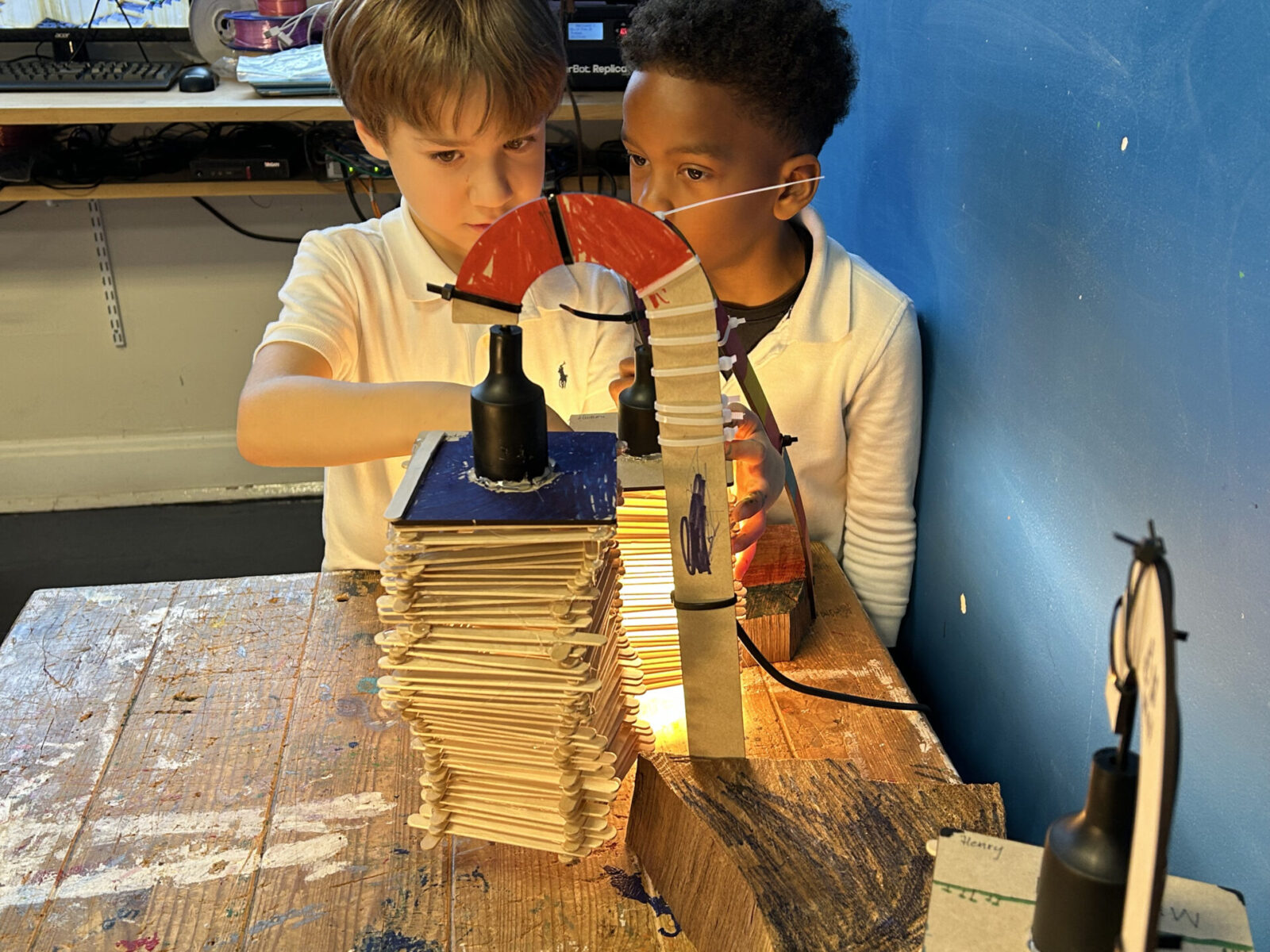
Click here for Unquowa’s STEM Day family guide
Watch a young child encounter something unfamiliar, and you will witness curiosity in its most natural form. There is little hesitation in asking why, taking something apart, or imagining that an ordinary object might become something entirely different. Children are wonderfully unconcerned with whether their questions are sophisticated or their first attempts successful. Somewhere along the way, however, the desire to understand can give way to the desire to be right. The question becomes less important than the answer, and the possibility of being wrong begins to feel like something to avoid.
National STEM Day invites us to reconsider what we value in the learning process.
Science, technology, engineering, and mathematics are often associated with precision, logic, and measurable outcomes. Yet the intellectual habits at the heart of these disciplines are remarkably imaginative. Scientific discovery begins with a question. Engineering begins with a problem not yet solved. Innovation requires the willingness to challenge what we think we know. At Unquowa, this understanding has informed our approach to education since 1917. Learning by doing, questioning, and experimenting.
Our 1,500-square-foot Makerspace, where the garage meets the classroom, gives physical expression to this philosophy. Here, students work with wood, textiles, robotics, and 3-D printing, translating ideas into objects that can be examined, tested, dismantled, and reimagined. Our Makerspace Coordinator, Joey Casey, whose background is in design, understands that the creative process is rarely a straight line. In Joey’s words, “design teaches us that an idea is not something to defend, but something to investigate. When students learn to question their assumptions, test possibilities, and revise their thinking, they begin to understand that creativity and critical thinking are inseparable.” A failed design is not necessarily a failed endeavor. An unexpected result may reveal more than a predictable success. The student who pauses to reconsider an assumption is engaged in intellectual work every bit as important as the student who arrives at the correct answer.
This has implications for the language we use with children. When we praise them for being smart, we may inadvertently suggest that intelligence is something to demonstrate rather than develop.
When we notice the quality of a question, the ingenuity of an approach, or the willingness to begin again, we honor the thinking itself. Nor should we be too quick to rescue children from frustration. There is a difference between allowing a child to struggle without support and helping a child discover that difficulty need not signal defeat. Knowing when to intervene, when to ask another question, and when simply to give an idea room to develop is among the more nuanced responsibilities of teaching.
Ultimately, the habits cultivated through STEM extend well beyond the laboratory or Makerspace. They belong equally to the historian examining conflicting accounts, the writer revising a sentence, and the child learning to see a familiar problem from an unfamiliar perspective. Education should do more than equip children with answers to the questions we already know how to ask. It should cultivate the curiosity, judgment, and intellectual courage to confront those we have yet to imagine.
← Before High School, Every Child Deserves the Chance to Lead